
The cigarettes segment had a revenue of Rs 4,554.21 crore during the second quarter of the current fiscal, as against Rs 8,528.47 crore in the year-ago period, down 46.56 per cent.

Cooking gas LPG price on Wednesday was hiked by Rs 50 per cylinder, the third increase in rates since May on firming international energy prices. Non-subsidised LPG now costs Rs 1,053 per 14.2-kg cylinder in the national capital, up from Rs 1,003 previously, according to a price notification of state-owned fuel retailers. Common households pay non-subsidised rates for the cooking gas they buy, after the government restricted subsidy to just poor beneficiaries who got connections under the Ujjwala scheme.

The government has brought in changes to the investment pattern for non-government provident funds, and superannuation and gratuity funds, enabling them to invest up to 5 per cent in the units of Category I and Category II alternative investment funds (AIFs), subject to some caveats. The development is part of the central government's strategy to channelise domestic savings and improve their returns to attract more investment in the said sectors. At present, these funds typically invest a minimum 45 per cent in government securities, besides new instruments, such as exchange-traded funds and real estate investment funds, while a portion in equity-related instruments.

'The market was expecting the Budget to do more, given the domestic economic slowdown and global uncertainty. Over the next few days, the market is expected to absorb the volatility.'

Liquidity issues post the crisis at DHFL, progress of monsoon, rupee trajectory at the domestic level and oil prices are some factors that will keep markets choppy, analysts say.

American brokerage firm Morgan Stanley on Thursday sharply cut its India FY23 real GDP growth estimate to 7.9 per cent, mainly due to the impact of the Russia-Ukraine conflict on oil prices. Analysts at the brokerage also raised their inflation forecast to 6 per cent - the upper end of the tolerance band for the RBI - and flagged stagflation risks because of the ongoing events. "We believe that the ongoing geopolitical tensions exacerbate external risks and impart a stagflationary impulse to the economy," they said. It can be noted that stagflation involves a stagnancy in output or growth, coupled with high inflation.

Whether one likes it or not, services constitute the value-addition sector that the country has to build on, using its comparative advantage in infotech and related skills, suggests T N Ninan.

Macroeconomic management is usually a lot more comfortable with lower fiscal deficits. The sooner we get there, the better for the economy, says former Chief Economic Adviser to the Government of India Shankar Acharya.

In this round, the market has won. But it is still for Gautam Adani to decide whether he has lost or not, argues Shekhar Gupta.

The broader NSE Nifty jumped 57.25 points or 0.49 per cent to close at 11,844.10.
.jpg)
The trade deficit makes up an important part of the current account deficit, which had touched an all-time high of 4.8 per cent in 2012-13.

'To simply let the rupee depreciate to any level according to market forces will not be in the country's interests.'

Neutrality and jurisdiction in international trade need to be discussed threadbare before GST is implemented in India.

Sectors throw up a wishlist for the Finance Minister.

To keep investors' confidence, however, Modi's government will need to be seen containing the fiscal deficit, while also increasing spending in key areas of the slowing economy.

Jaitley said a very large number of reforms have taken place over the last few years and that has helped in restoring the credibility of the Indian economy

Goods and Services Tax (GST) collections at Rs 95,480 crore in September touched the highest level so far this fiscal, the finance ministry said on Thursday.

Bajaj Auto and TVS Motor are the largest exporters in the listed space with export revenues of Rs 12,000 crore and Rs 5,000 crore.

'The international community is moving away from harmful tax practices.'

PowerGrid was the top gainer in the Sensex pack, rallying over 4 per cent, followed by NTPC, UltraTech Cement, Tech Mahindra, Reliance Industries and IndusInd Bank.

The derivatives (futures and options) are not treated as capital asset and the income arising from the transfer of the derivatives is treated as business income and liable for normal rate of tax for domestic investors, an official statement said on Saturday, clarifying the stand of tax authorities on gains made from derivatives trading.

India's economic growth is now 'extremely fragile' and needs all the support that it can get, as private consumption and capital investment are yet to pick up, RBI Monetary Policy Committee (MPC) member Jayanth R Varma said on Friday. Varma further said out of the four engines of growth for the economy, exports and government spending supported the Indian economy through the pandemic, but other engines need to pick up the baton now. " I like to think in terms of the four engines of growth for the economy: exports, government spending, capital investment and private consumption. "...while exports cannot be the main driver of growth because of the global slowdown, government spending is necessarily limited by fiscal constraints," he told PTI.

Market benchmarks gave up intra-day gains to close in the red for the sixth session on the trot on Friday, capping a bruising week which saw a massive dash for safety amid rate hikes by global central banks and fears of slowing growth.

The Finance Ministry has sought comments from stakeholders.

Despite a slowing economy, the Budget does not envisage any major stimulus through the budgeted fiscal deficit figures, said Goldman Sachs.

Earning numbers of blue-chips, including ITC and SBI, due tomorrow.

Every patriot should learn from our history and recognise that celebrating size will neither negate nor obscure the huge economic challenges that India faces, asserts Rathin Roy.

Market players say following the tax cuts, the market mood had changed from bearish to positive, which should help sustain the rally.
While efforts are being mounted on a war footing to arrest its spread, COVID-19 will impact economic activity in India directly through domestic lockdown. The second-round effects, it said, would operate through a severe slowdown in global trade and growth.

GJEPC seeks two year Direct and Indirect tax holiday on export earnings of Gems and Jewellery Industry, considering difficult export market faced in the current fiscal

Conformity assessment procedures will be put in place to verify that goods and services sold on e-commerce platforms meet required standards and technical regulations, according to the draft e-commerce policy. The policy, which is under discussion, also stated that actions and things which cannot be done by the online platform entities "can also not be done" by any of its associates and related parties. Government may, from time to time, notify parties which fall in the definition of associates and related parties, it said.

With this, India joins 60 other countries that collect PNR details of international passengers.

The Street was hoping that investors will lap up shares of high-dividend companies on optimism that their payouts will increase further, thanks to the 20 per cent tax saving. However, the trade failed to materialise as wealthy investors stayed away fearing high tax outgo, and experts raised doubts on whether companies would actually increase cash dole outs.

'As the 1991 experience showed, the solution to a large trade deficit may be to open up the economy, not putting up protective walls,' points out T N Ninan.


The goods and services tax will level the playing field for different sectors of industry, including domestic manufacturing.
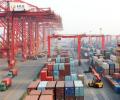
Chinese manufacturers are re-routing their products through the markets of other countries that India has Free Trade Agreements with.

India has been relatively insulated from the severe headwinds in the West. However, with a third of the global economy expected to slip into recession in calendar year 2023, the impact will strongly be felt on India's exports and trade economy, leading economists said in a panel discussion at the Business Standard BFSI Insight Summit in Mumbai on Wednesday. The panel comprised former Reserve Bank of India executive director and former Monetary Policy Committee member Mridul Saggar, State Bank of India Chief Economic Advisor Soumya Kanti Ghosh, Citibank India Chief Economist Samiran Chakraborty, ICRA Chief Economist Aditi Nayar, and IndusInd Bank Chief Economist Gaurav Kapoor. The topic of the panel discussion was No recession in sight: Is India decoupled from developed economies?

Subdued Asian and European markets due to escalating trade war between the US and China mainly led to caution on domestic bourses, brokers said.

The country's gross domestic product (GDP) is likely to grow more than 9.5 per cent in fiscal 2021-22, an SBI research report-Ecowrap said. The economy grew at 8.4 per cent in the second quarter of the current fiscal, according to data released by the National Statistical Office (NSO) on Tuesday. The growth in the April-June quarter of this fiscal stood at 20.1 per cent. In October's monetary policy review, the Reserve Bank of India had retained its projection for real GDP growth at 9.5 per cent in 2021-22, consisting of 7.9 per cent in Q2; 6.8 per cent in Q3; and 6.1 per cent in Q4 of 2021-22.
